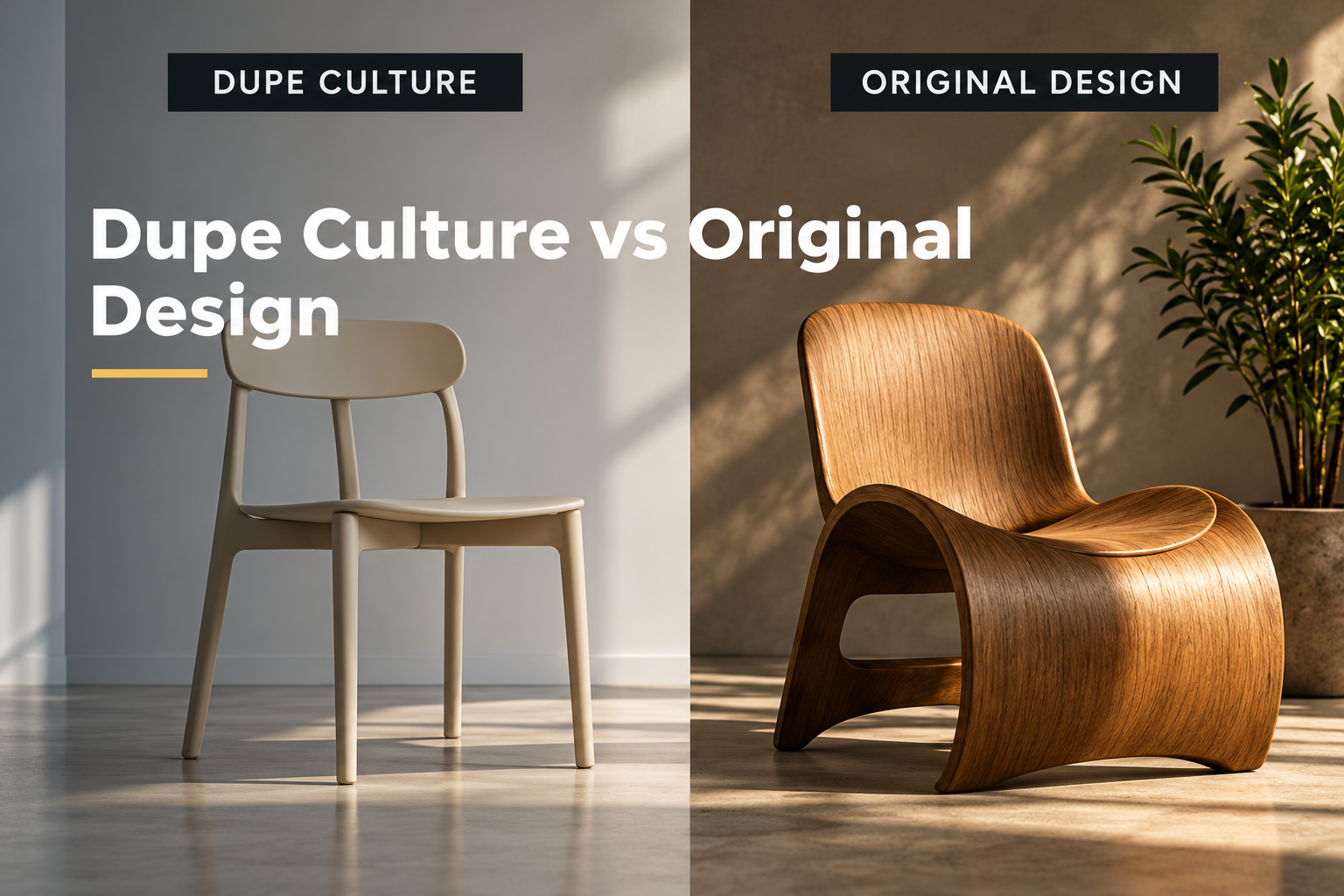
Dupe Culture vs Original Design: What Makes Creativity Worth Paying For?
Why everyone is talking about dupes
From a chair inspired by a famous silhouette to a handbag that resembles a luxury release, social platforms have made “dupes” part of everyday shopping language. These lower-priced alternatives appeal to people who admire a visual idea but cannot or do not want to pay for the original. The issue becomes more complicated when resemblance turns into copying.
Not every affordable alternative is unethical, and not every premium product is automatically good design. The useful question is what has been copied, what has been transformed and what the product delivers.
What counts as a dupe—and what does not?
A dupe is usually marketed as a cheaper substitute with a similar appearance or function. A product drawing on a broad style, such as minimalism or mid-century furniture, is different from one reproducing a distinctive protected pattern, logo or design with minimal changes.
The legal position depends on jurisdiction and specific rights, including trademarks, registered designs and copyright where applicable. Similarity alone does not prove infringement, so broad claims about legality should be avoided.
The hidden work behind an original design
A convincing original often begins long before the finished photograph: audience research, cultural references, sketches, material sampling, prototypes, user testing and repeated revisions. The designer weighs comfort, manufacturing, durability, cost and meaning.
Consider two visually similar chairs. Their profiles may look alike online, yet joinery, ergonomics, material sourcing, finish quality and repairability can differ greatly. The same holds for garments: fit, pattern engineering, stitching and responsible production can materially change the experience.
Why dupes appeal to consumers
Affordability and access matter. A student furnishing a rented flat may choose a budget piece, while someone experimenting with a trend may prefer a low-commitment purchase. Social media also rewards recognisable aesthetics, encouraging shopping based on resemblance rather than design history.
At the same time, an endless cycle of disposable lookalikes can contribute to overconsumption. The more constructive comparison is not luxury versus budget, but short-term imitation versus thoughtful value at any price.
Originality does not mean designing in isolation
Designers always learn from predecessors, regional crafts, public spaces, historical movements and shared visual languages. Responsible originality means interpreting these influences through new research, function, context or storytelling. Give appropriate credit when referencing another creator, and distinguish inspiration from close replication.
A contemporary collection inspired by Indian weaving traditions, for example, becomes stronger when it engages artisans and acknowledges sources rather than treating craft as anonymous decoration.
How design students can move beyond copying
Build a reference board and annotate why each example works. Then write a unique problem statement: who is the user, what is missing and what constraints shape the solution? Sketch multiple options, test them and record what changes after feedback.
A credible portfolio shows process: source material, original exploration, prototypes, failures and justified final decisions. Copying a popular visual style may demonstrate software skills; solving a new problem demonstrates design thinking.
How buyers can choose more thoughtfully
Compare build quality, materials, longevity, warranties and repair options. Look for honest product descriptions and avoid counterfeit branding. Support independent designers and craftspeople where your budget permits, but remember that a responsibly designed affordable product can also be original.
Buying fewer, better-suited objects may serve people and the environment more effectively than chasing every new viral aesthetic.
The difference between reference and replication
Every designer learns by looking at existing work. A fashion student may study the silhouette of a classic jacket, while an interior designer might analyze the proportions of a famous chair. Learning from those references is not the same as selling a nearly identical object under a different name. The distinction often lies in how many defining features are carried over, whether the new work has independent creative thinking and how it is presented to customers. Legal protection varies by category and jurisdiction, so a visual similarity is not automatically proof of infringement.
Why the price gap can be misleading
A lower retail price may reflect many different factors: material choices, factory scale, distribution strategy or the absence of the research and prototyping costs invested in an original. A cheaper object is not automatically inferior, just as a higher-priced original is not guaranteed to be ethically made. The better comparison includes finish quality, repairability, durability, sourcing and the total cost of ownership. For products used daily, replacement frequency can matter more than an attractive opening price.
Social media shortens the design cycle
An image can travel from a runway, exhibition or furniture fair to thousands of screens within hours. Trends become recognizable before audiences understand where they came from. Short-form content often rewards the visual resemblance of a dupe rather than the story behind the original. At the same time, digital platforms help emerging independent designers reach customers directly. The challenge is building recognition for distinct design thinking without relying on imitation to achieve attention.
Originality is a process, not a sudden idea
Original design usually begins with research: a user need, a material limitation, a cultural question or a problem worth solving. Designers then sketch, test, reject, refine and test again. An idea that appears simple in its finished form may contain dozens of small decisions around comfort, construction, cost and usability. Understanding this process helps explain why a signature object or collection may command value beyond the price of its physical components.
Cultural inspiration needs care
Traditional embroidery, craft practices, regional furniture forms and local motifs are rich sources of inspiration. They also raise questions about acknowledgement and fair collaboration. Designers can strengthen their work by researching the communities associated with specific techniques, involving craftspeople meaningfully and avoiding claims of invention for inherited knowledge. A contemporary interpretation becomes more compelling when it offers context rather than stripping a visual element from its origins.
What thoughtful consumers can ask
Before purchasing a trend-led item, consider who made it, whether the original creator is identifiable and how long the product is likely to be used. Check materials and construction, ask about repair options and look for transparent information from sellers. Buying second-hand originals, choosing emerging labels and investing in fewer durable pieces may be useful alternatives. The goal is not to shame budget-conscious shoppers, but to make the trade-offs visible.
How design schools can teach originality
One useful classroom exercise is to assign everyone the same inspiration image but ask for different functional briefs. One student may design for compact urban homes, another for a different body type or for a local material constraint. The final review should consider research notes and failed prototypes, not only the polished result. Showing the journey helps students develop a personal design language and recognize the importance of attribution and intellectual property literacy.
A future beyond the copy-paste aesthetic
Dupe culture is unlikely to disappear while trends move quickly and audiences seek affordable alternatives. Yet it creates an opportunity for designers to communicate why their work is distinct. Clear storytelling around materials, process, longevity and craft can help customers see the difference between a passing resemblance and a considered design. That is where originality becomes more than a marketing claim: it becomes an enduring creative practice.
Conclusion
Dupe culture raises a valuable design question: are we buying an appearance or a considered solution? For the next generation of fashion, interior and graphic designers, originality means creating value through purpose, craft and responsible experimentation.